Prediction vs Explanation: Using Machine Learning in Research
Machine learning is now common in management and social-science research, but it is often used to answer the wrong question. The distinction between predicting an outcome and explaining it is the most important idea to get right—and the one most often blurred. This guide makes it clear.
Machine learning has moved from computer science into the everyday toolkit of management, economics, and social-science research. Used well, it is genuinely powerful. Used without clarity about what it is for, it produces papers that report a high accuracy score and then draw conclusions the analysis cannot support. Almost every one of those missteps traces back to a single confusion: mistaking prediction for explanation. They are different goals, they call for different methods, and they license different conclusions.
This guide sets out the distinction, explains why a highly accurate model tells you little about cause, and describes how to use machine learning appropriately for each aim. It reflects how we approach machine learning within our Machine Learning, AI & Text-as-Data practice, and it builds on the same claim-first logic in our guide to choosing the right statistical method.
Two different questions
Prediction asks: given what I can observe, how accurately can I forecast an outcome I cannot yet see? The goal is a model that performs well on new, unseen data. It does not matter, for this purpose, why the model works—only that it does. If a model predicts customer churn, loan default, or which papers will be highly cited with high accuracy on data it was not trained on, it has done its job, even if its inner workings are opaque.
Explanation asks a different question: what actually drives this outcome, and by how much? Here the goal is understanding—ideally causal understanding—of the relationships between variables. A high accuracy score is neither necessary nor sufficient for this. You can predict something well using variables that merely correlate with it, and you can have a modest predictive model that nonetheless isolates a genuine causal effect. Explanation is about the mechanism; prediction is about the forecast. Machine learning, historically, was built and optimised for the first.
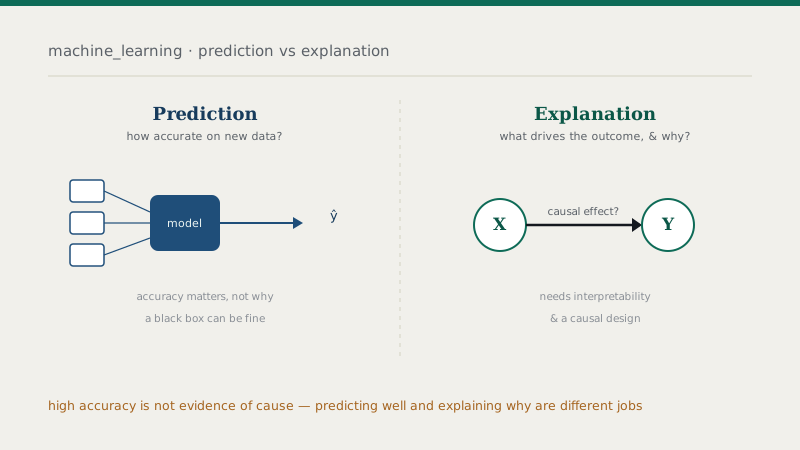
| Prediction | Explanation | |
|---|---|---|
| Question | How accurately can I forecast the outcome? | What drives the outcome, and by how much? |
| Goal | Performance on new data | Understanding, ideally causal |
| Black-box OK? | Yes, if it predicts well | No – needs interpretability |
| Evaluated by | Out-of-sample accuracy | Identification / causal design |
| Feature importance | Useful for prediction | NOT a causal effect |
Why accuracy is not evidence of cause
The most consequential error in applied machine-learning research is treating a variable's importance in a predictive model as evidence that it causes the outcome. It is not. Predictive models exploit any statistical association that helps them forecast, including associations driven by confounding, reverse causation, or coincidence. A variable can be highly “important” to a model's predictions precisely because it is a downstream consequence of the outcome, or a proxy for some unmeasured cause—neither of which supports a causal story.
This is the same lesson that runs through all of causal analysis: correlation, however sophisticated the algorithm detecting it, is not causation. A model that predicts hospital readmission well may lean heavily on a variable that is a symptom of the underlying condition rather than a lever anyone could pull. Acting on that variable as though it were causal—because the model ranked it highly—would be a mistake. High predictive accuracy earns trust in the forecast; it earns no trust at all in a causal interpretation of the features.
A feature's predictive importance is not its causal effect. Variable-importance scores tell you what helps the model forecast—not what would change the outcome if you intervened. Reading them as causal is the single most common error in applied ML research.
Using ML well for prediction
When your goal genuinely is prediction, machine learning is often the right tool, and the discipline that matters is honest evaluation. The cardinal risk is overfitting: a model that captures noise in the data it was trained on and consequently performs worse on new data. A model can be made to fit historical data almost perfectly and still be useless for forecasting—the impressive in-sample fit is precisely the warning sign.
The safeguard is rigorous out-of-sample evaluation: assessing the model on data it never saw during training, typically through a held-out test set and cross-validation, so that reported performance reflects genuine predictive ability rather than memorised noise. For a predictive study, this is the evidence that matters, and reviewers who understand machine learning will look for it. In-sample accuracy, by contrast, proves almost nothing. Getting this right is most of what separates a credible predictive study from an exercise in self-deception.
Using ML well for explanation
When the goal is explanation, machine learning still has a role—but a different one, and always in service of understanding rather than raw accuracy. Two developments are especially relevant. The first is interpretable machine learning: a family of techniques for opening up complex models to see how features relate to predictions. These tools are valuable for generating hypotheses and for transparency, but they describe the model's behaviour, not the world—they explain what the model does, which is not the same as explaining what causes the outcome.
The second, more powerful, development is the growing field that combines machine learning with causal inference. These methods use the flexibility of machine learning—its ability to handle many variables and complex relationships—within a design built to identify causal effects, rather than merely to predict. This is where machine learning genuinely contributes to explanation: not by ranking features in a predictive model, but by being embedded in a framework that takes identification seriously, of the kind our causal inference work is built around. The tool is powerful; what makes it yield explanation rather than mere prediction is the causal design around it.
Ask the prediction-or-explanation question first
Before reaching for a machine-learning model, decide honestly which question you are answering. If you need an accurate forecast and do not need to know why, a predictive approach—evaluated out-of-sample—is appropriate, and a degree of black-box opacity may be perfectly acceptable. If you need to understand what drives an outcome, or to inform an intervention, then predictive accuracy is not enough; you need interpretability at minimum, and a causal design if you intend to claim an effect. The methods, the evaluation, and the conclusions you are entitled to draw all follow from that first decision.
Confusing the two is what produces the recognisable failure mode: a paper that trains a predictive model, reports its accuracy, reads its most important features as causes, and recommends acting on them. Each step is fine on its own terms; the chain is broken at the point where prediction is silently promoted to explanation. Keeping the two goals distinct—and matching the method and the claim to the goal—is what makes machine learning a genuine contribution to research rather than a sophisticated way to overclaim.
The bottom line
Machine learning is not a single tool with a single purpose; it serves prediction and explanation, which are different jobs. Predictive accuracy, however high, is not evidence of cause, and a feature's importance to a model is not its effect on the world. Use machine learning for prediction with honest out-of-sample evaluation; use it for explanation only through interpretable methods for insight and, for causal claims, a design that identifies effects. Decide which question you are answering before you start, and let that decision govern the method and the conclusions. Do that, and machine learning earns its place in serious research.
Frequently asked questions
Applying machine learning to a research question?
From predictive modelling evaluated out-of-sample to interpretable and causal ML, our team can help you use machine learning for the right goal—and defend the result.