Understanding Endogeneity and How to Address It
Endogeneity is the single most common reason a regression coefficient cannot be read as a causal effect—and the objection a good reviewer raises first. This guide explains what it is, where it comes from, and the main strategies for dealing with it, in plain terms.
You have run your regression, the coefficient on your key variable is significant, and it points the way your theory predicted. It is tempting to conclude that you have found an effect. But an experienced reviewer will ask a harder question first: how do you know this coefficient reflects a genuine effect of X on Y, rather than something else masquerading as one? That question is almost always about endogeneity—and it is the issue that most often separates a correlation dressed up as a finding from a credible causal claim.
Endogeneity sounds technical, and the mathematics can be, but the underlying idea is intuitive. This article explains what endogeneity is, the three main ways it arises, and the principal strategies for addressing it—without drowning the intuition in algebra. It builds on our guide to choosing the right statistical method and reflects how we handle identification within our Econometrics & Quantitative Research practice.
What endogeneity actually means
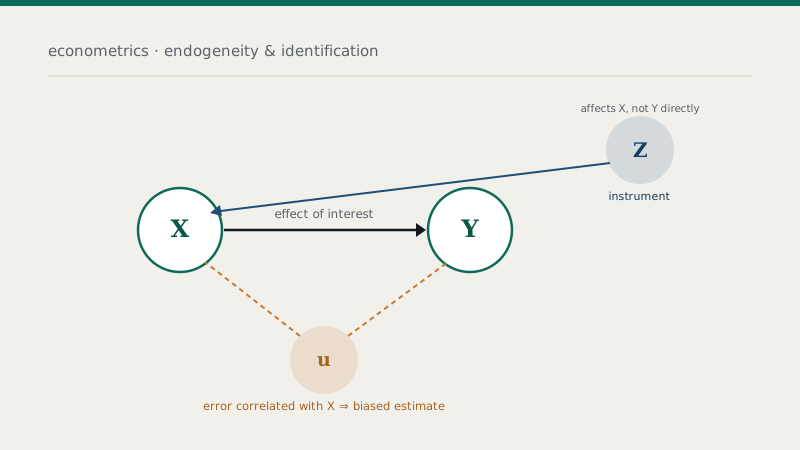
Every regression carries an error term—everything affecting the outcome that the model does not explicitly include. The central assumption that lets a regression coefficient be interpreted as an effect is that the explanatory variable is uncorrelated with this error term. When that assumption holds, the variable is said to be exogenous, and the estimate is unbiased. When it fails—when the explanatory variable is correlated with the error—the variable is endogenous, and the estimate is biased. It no longer isolates the effect of X on Y; it also picks up whatever in the error is moving alongside X.
The intuition is that a regression compares outcomes across different values of X and attributes the difference to X. That attribution is only valid if the units with different values of X are otherwise comparable. If something hidden in the error term is both correlated with X and affecting Y, then units with high and low X differ in more than just X—and the coefficient absorbs that difference too. The estimate is contaminated, often in a direction you cannot even sign with confidence.
Where endogeneity comes from
Endogeneity is not one problem but a family of them, arising through three main channels. Recognising which one threatens your study is the first step to addressing it.
The first and most common is omitted variable bias. If a variable that affects the outcome is left out of the model, and that omitted variable is correlated with an included explanatory variable, its influence loads onto the included variable's coefficient. The classic example is estimating the return to education on earnings without accounting for ability: more able people tend to get more education and earn more, so the education coefficient captures part of ability's effect. The omitted variable sits in the error term, correlated with education, and biases the estimate.
The second is simultaneity or reverse causality, where X affects Y but Y also affects X. Estimating the effect of police numbers on crime is a canonical case: more police may reduce crime, but cities with more crime also tend to hire more police. The two determine each other, so a simple regression cannot tell how much of the observed relationship runs in each direction.
The third is measurement error in an explanatory variable. When a variable is measured imprecisely—a survey proxy for a true underlying quantity, for instance—the mismeasurement enters the error term and is, by construction, correlated with the mismeasured variable. This typically biases the coefficient toward zero, understating a real effect.
The common thread: in every case, the explanatory variable ends up correlated with the error term. That correlation—however it arose—is what makes the coefficient biased and blocks a causal interpretation.
Strategy 1: control for confounders
The most direct response to omitted variable bias is to stop omitting the variable—measure the confounder and include it. If ability is the problem, include a measure of ability. This is the everyday logic of adding controls to a regression, and where a confounder is observable and well measured, it is often enough.
Its limitation is obvious: you can only control for what you can measure. Many of the most important confounders—ability, motivation, management quality, institutional culture—are hard or impossible to observe directly. Adding controls also cannot fix simultaneity or measurement error. So while controlling for confounders is the first line of defence, it is rarely a complete one for observational data, and asserting that you have “controlled for everything relevant” is exactly the claim a reviewer will not take on trust.
Strategy 2: exploit panel data
When you observe the same units over time, panel-data methods offer real leverage. A fixed-effects model absorbs every stable, time-invariant characteristic of each unit—including unobserved ones—because it uses only within-unit variation. If the omitted confounder is a fixed trait of the unit, such as an individual's innate ability or a firm's enduring culture, fixed effects remove it entirely without your ever having to measure it.
This is powerful, but it addresses only the part of endogeneity driven by time-invariant unobservables. It does nothing about confounders that change over time, about simultaneity, or about measurement error. Panel methods are a major tool against endogeneity, not a universal solution.
Strategy 3: instrumental variables
When the confounder is unobservable and not simply a fixed trait, or when simultaneity is the problem, the classic solution is an instrumental variable. An instrument is a variable—call it Z—that affects the endogenous explanatory variable X but has no direct effect on the outcome Y except through X, and is uncorrelated with the error term. The idea is to isolate the part of X's variation that is driven by Z, which is “clean” of the contamination, and use only that part to estimate the effect on Y. This is the logic behind two-stage least squares and the broader instrumental-variables toolkit.
Instruments are elegant in theory and demanding in practice. A valid instrument must satisfy two conditions: it must be genuinely related to X (relevance), and it must affect Y only through X (the exclusion restriction). The exclusion restriction cannot be fully tested statistically—it rests on an argument about how the world works—and weak instruments, which are only loosely related to X, can produce estimates that are worse than doing nothing. Finding a credible instrument is genuinely hard, and reviewers scrutinise them closely. When a good one exists, though, it can rescue a causal claim that no amount of control variables could.
Strategy 4: quasi-experimental designs
Often the strongest response to endogeneity is not a statistical fix applied after the fact but a research design that avoids the problem from the start. If you can find a situation where the explanatory variable varies for reasons plausibly unrelated to the outcome—a policy that applied to some units and not others, a threshold that assigned treatment, a natural experiment—you can estimate an effect much more credibly. This is the domain of causal inference: difference-in-differences, regression discontinuity, and related designs exploit exactly this kind of variation. Rather than assuming X is as good as randomly assigned, these designs find or approximate circumstances in which it genuinely is.
How to think about it in your own work
Before running a regression you intend to interpret causally, ask the endogeneity question directly: is there any reason my explanatory variable might be correlated with the error term? Work through the three channels—is there a plausible omitted confounder, could the causality run backwards, is the variable measured with error? If the answer to any is yes, a plain regression coefficient will not support a causal claim, and you need one of the strategies above.
Which strategy fits depends on the source of the problem and the data you have: controls for observable confounders, fixed effects for time-invariant unobservables, instruments or quasi-experimental designs for the harder cases. Often the most convincing papers combine approaches and show that the result survives more than one. What a reviewer wants to see is not a claim that endogeneity is absent, but evidence that you understood the threat and confronted it. Treating endogeneity as a question to answer honestly—rather than a box to tick—is what turns a suggestive correlation into a defensible finding.
Frequently asked questions
Need a defensible identification strategy?
From diagnosing endogeneity to instrumental variables and quasi-experimental designs, our team can help you build—and defend—a credible causal claim.