How to Choose the Right Journal for Your Paper
Where you submit is one of the most consequential decisions in the publication process—and one of the most rushed. A strong paper sent to the wrong journal is routinely rejected on fit rather than merit. This guide explains how to choose well, and what actually decides most submissions.
You have finished the paper. Now comes a decision that will shape how long it takes to publish, who reads it, and whether it is accepted at all: which journal to submit to. It is tempting to treat this as a quick final step—pick the most prestigious title in the field and send it—but that instinct is behind a large share of avoidable rejections. Journals reject far more papers on grounds of fit than on grounds of quality, and a well-matched journal will often move a paper through review that a mismatched one would desk-reject in a week.
This guide sets out how to choose the right journal deliberately: what “fit” actually means, how to build and narrow a shortlist, and how to weigh prestige against realistic prospects. It is the companion to our Journal Finder, which helps you verify a journal's indexing and metrics through official sources; here the focus is the judgement that comes before verification—deciding where your paper belongs.
Fit matters more than prestige
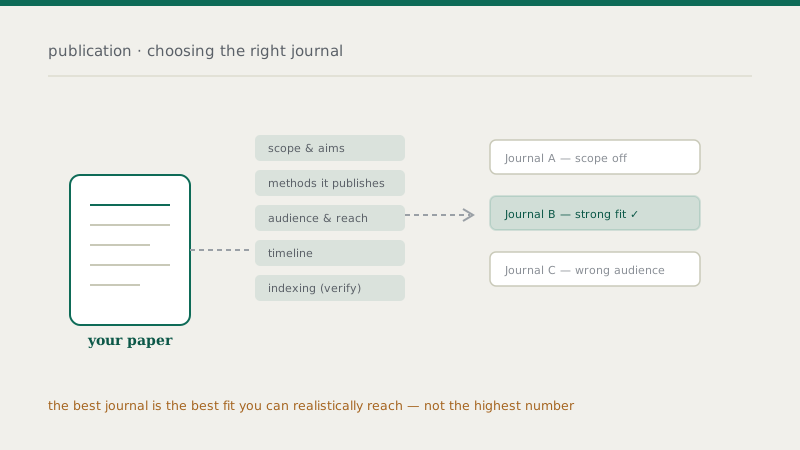
The single most important idea in journal selection is that fit usually matters more than the metric. A journal with a modest quartile but exactly the right scope and readership frequently serves a paper better than a higher-ranked journal where the work sits at the edge of what the journal publishes. Aiming automatically for the highest-ranked title is not ambition; it is often a way to waste months on a predictable desk rejection.
This does not mean abandoning ambition. It means matching your paper to the best-fitting journal it can realistically reach—stretching toward strong venues where the fit is genuine, while being honest about which journals your contribution and its execution can support. The goal is publication in a journal whose readers are the people your work is meant to reach, at a level the paper can actually attain. Prestige is one input to that judgement, not the whole of it.
What “fit” actually means
Fit is not a vague feeling; it has concrete components you can assess.
The first is scope and aims. Every journal publishes a statement of what it wants, and it should be read closely—then checked against reality by reading several recent issues. Does the journal publish papers on your topic, asking your kind of question, making your kind of contribution? If your paper does not resemble what the journal has published lately, the fit is weak however eminent the title.
The second is methodology. Journals develop methodological characters. Some favour large-sample quantitative work, others qualitative or mixed methods, others formal modelling. A paper built on one approach submitted to a journal that publishes only another is a poor fit even within the right field—a mismatch reviewers notice immediately.
The third is audience and reach. Publication exists so that the right people read and build on your work. A specialist journal read closely by exactly the community your paper speaks to can serve it better than a broader journal where it will be overlooked. Ask who reads the journal, and whether they are the readers you want.
The fourth is contribution type. Journals differ in what they reward—some prize theoretical novelty, others empirical rigour, others practical relevance or methodological innovation. Matching the nature of your contribution to what a journal values is part of fit.
Your reference list is often your best shortlist. The journals you cite most are, by definition, publishing the conversation your paper is joining—which makes them strong candidates worth examining first.
Building and narrowing a shortlist
A good process starts wide and narrows deliberately. Begin from the journals you cite most heavily—they are publishing your literature and are natural homes for your contribution. Widen the list using the scope statements of related journals and, where useful, a discovery tool to surface venues in your area. Aim for a handful of genuine candidates rather than a single fixed target, so that a rejection is a redirection rather than a restart.
Then narrow by fit. For each candidate, read the aims and scope and several recent papers, and ask honestly whether your question, method, and contribution belong there. Drop the ones that do not, however tempting the name. What remains is a ranked shortlist of journals where your paper genuinely fits—the raw material for a submission strategy rather than a single hopeful shot.
Weighing prestige, timeline, and prospects
With a shortlist of well-fitting journals, other factors come into play. Prestige and reach matter, but so does turnaround: some journals reach a first decision in weeks, others in many months, and if you face a submission deadline, a funding window, or a career milestone, a realistic timeline can matter as much as the quartile. Acceptance prospects matter too—an honest assessment of how competitive a journal is against the strength of your paper. The strongest strategy orders your shortlist by fit, then balances prestige, timeline, and realistic prospects against your own constraints, and submits to one journal at a time, keeping the next ready.
Verify before you submit
Once you have a target, verify the practical facts before submitting—because indexing status, and the legitimacy of a journal, can and do change. Confirm the journal is genuinely indexed where it claims to be, check its current standing through official sources, and if the venue is unfamiliar, screen it for the signs of a predatory or hijacked journal before you trust it with your work. Our Journal Finder links directly to the authoritative sources for exactly this verification. Choosing a journal is a judgement about fit; confirming it is a check against the official record, and both steps matter.
The bottom line
Choosing a journal well is a deliberate match, not a reflex toward the biggest name. Fit—scope, methodology, audience, and contribution type—usually matters more than prestige, and the best target is the best-fitting journal your paper can realistically reach. Build a shortlist from the journals you cite, narrow it honestly by fit, weigh prestige against timeline and prospects, and verify the practical facts before you submit. Approached this way, journal selection stops being a gamble and becomes what it should be: a considered decision that gives good work its best chance of being published—and read.
MAS Research supports authors in selecting and targeting journals; we do not guarantee acceptance or publication, which rest with the journal's editorial and peer-review process.
Frequently asked questions
Want help targeting the right journal?
Our publication team can assess your paper against candidate journals—scope, methods, recent output, and realistic timelines—and hand you a ranked, verified shortlist.