Correlation vs Regression: What’s the Difference?
They are among the first tools researchers learn, they are closely related, and they are constantly confused. Understanding what correlation and regression each do—and what neither can do—is the foundation for every quantitative analysis that follows.
Correlation and regression are the workhorses of quantitative research, and they are also the source of some of its most common misunderstandings. They are related—both describe how two variables move together—but they answer different questions, produce different things, and support different conclusions. Getting the distinction clear is not a matter of terminology; it shapes what you can legitimately claim from your data. This guide explains what each one does, how they differ, and the trap they share.
It is a foundational piece in our Econometrics & Quantitative Research practice, and it sits underneath everything in our guide to choosing the right statistical method—because knowing what correlation and regression can and cannot tell you is where sound analysis begins.
What correlation measures
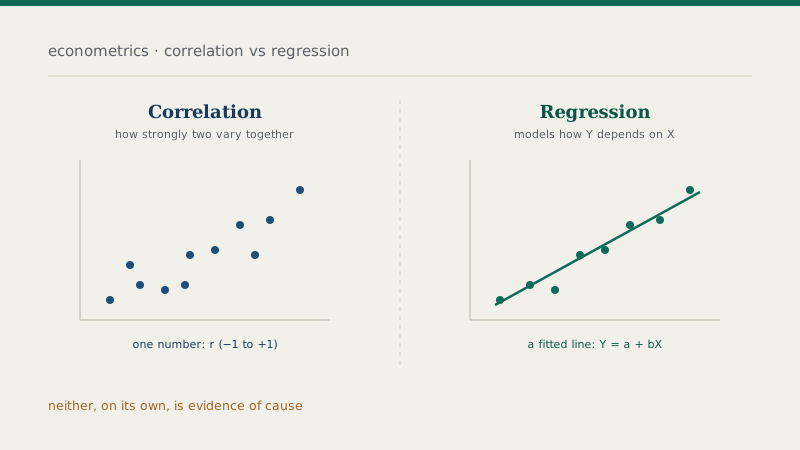
Correlation measures the strength and direction of the linear association between two variables, expressed as a single number—the correlation coefficient, usually denoted r—that ranges from −1 to +1. A value near +1 means the two variables tend to rise together; near −1 means one rises as the other falls; near 0 means little linear association. That single number is the whole output: correlation tells you how strongly two variables vary together, and nothing more.
It is symmetric—the correlation of X with Y is identical to the correlation of Y with X—because it makes no distinction between an explanatory variable and an outcome. It simply describes co-movement. This makes correlation an excellent quick summary of association, but it also means correlation cannot tell you anything about the form of the relationship, how much Y changes for a given change in X, or which variable might be driving the other.
What regression does
Regression goes further. Rather than summarising association in one number, it models how a dependent variable depends on one or more explanatory variables. In its simplest form it fits a line—Y = a + bX—that best describes how Y changes as X changes. The output is not a single coefficient of association but an equation: an intercept, a slope for each predictor, and measures of how well the model fits and how precisely each effect is estimated.
This gives regression capabilities correlation lacks. It is directional: it treats one variable as the outcome and others as predictors, so it distinguishes what is being explained from what is doing the explaining. It quantifies the relationship: the slope tells you how much Y changes, on average, for a one-unit change in X. It handles multiple predictors at once, estimating the effect of each while holding the others constant. And it supports prediction: given values of the predictors, it produces an expected value of the outcome. Regression is the tool when you want to understand or model a relationship, not just note that one exists.
The simplest way to hold the distinction: correlation asks “do these two move together, and how strongly?” Regression asks “how does this outcome depend on these predictors?” One describes association; the other models a relationship.
How they relate
The two are not unrelated—in the simplest case they are mathematically connected. For a simple regression of Y on a single X, the sign of the slope matches the sign of the correlation, and the correlation coefficient squared equals the proportion of variance in Y that the model explains. So simple linear regression and correlation are, in a sense, two views of the same two-variable relationship: correlation gives the standardised strength of association, regression gives the actual equation.
The relationship breaks down as soon as you move beyond two variables. Correlation is inherently a two-variable measure, while regression extends naturally to many predictors—and that is where regression’s real power lies. Multiple regression can estimate the effect of one variable while accounting for others, revealing relationships that simple correlations obscure and dissolving spurious ones that a raw correlation would show. This is why serious analysis rarely stops at correlation.
The trap they share: neither proves causation
The most important thing to understand about both tools is a limitation they have in common: neither correlation nor regression, by itself, establishes causation. That two variables are correlated does not mean one causes the other—they may both be driven by a third factor, the causality may run the opposite way, or the association may be coincidental. And crucially, running a regression does not fix this. A regression coefficient is still, fundamentally, a measure of association; dressing an association up in an equation with a significance test does not turn it into a causal effect.
This is a genuinely common and costly error: treating a significant regression coefficient as proof that X causes Y. Establishing causation requires more than either tool provides—it requires a research design that addresses confounding and identification, which is the domain of endogeneity and causal inference. Regression is often a component of a credible causal analysis, but the credibility comes from the design around it, not from the regression itself. Correlation and regression describe how variables relate; whether that relationship is causal is a separate question that neither can answer alone.
Which should you use?
Use correlation when you want a quick, standardised summary of how strongly two variables are associated—an exploratory first look, a check for association before modelling, or a compact way to report the relationships among several variables. Use regression when you want to model how an outcome depends on one or more predictors, quantify the size of those relationships, control for other variables, or predict. In practice, most substantive research questions call for regression, because they ask about how things depend on each other rather than merely whether they move together—but correlation remains a useful and honest tool for what it is designed to do.
Whichever you use, the discipline is the same: be clear about what the number means, don’t read more into it than it supports, and remember that describing a relationship and explaining it causally are two different tasks. Get that right, and correlation and regression become exactly what they should be—reliable first steps toward understanding your data, rather than shortcuts to conclusions they cannot support.
Frequently asked questions
Modelling relationships in your data?
From correlation and regression to the identification strategies that support causal claims, our team can help you analyse your data—and defend what you conclude.