Regression Discontinuity Design Explained
When a treatment is assigned by a strict cutoff on some score, one of the most credible quasi-experimental designs becomes available. Regression discontinuity turns an arbitrary threshold into a near-experiment—and it is prized precisely because its key assumption is so transparent.
Some of the most convincing causal evidence in economics and policy research comes from a design that exploits something mundane: an arbitrary cutoff. A scholarship awarded to students scoring above 80, a subsidy for firms below a size threshold, a programme for districts under a poverty line—wherever a treatment is assigned by whether some score crosses a fixed value, regression discontinuity design (RDD) can estimate its effect with a credibility that rivals a randomised experiment. It is a favourite of careful empirical researchers because the assumption it rests on is unusually easy to see and to defend.
This guide explains the intuition behind RDD, how it works, the assumption that makes it credible, its main variants, and its limitations. It completes the core quasi-experimental toolkit alongside our guides to difference-in-differences and instrumental variables, and reflects the design work in our Causal Inference & Policy Evaluation practice.
The core intuition
RDD applies when treatment is determined by whether a continuous variable—the running variable (or forcing variable)—falls above or below a fixed cutoff. Students scoring 80 or above get the scholarship; those below do not. The key insight is that a student who scored 79 and one who scored 81 are, in almost every respect, essentially the same—the two-point gap is largely noise, luck on the day. Yet one received the treatment and the other did not. Around the cutoff, in other words, treatment is as good as randomly assigned.
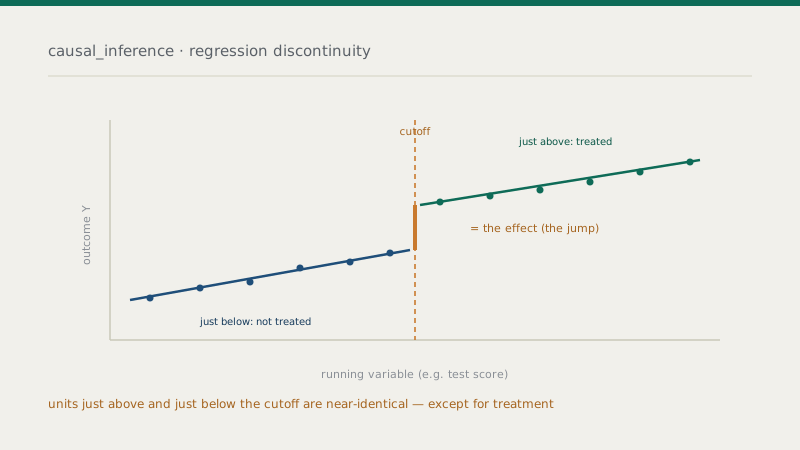
This lets us estimate the treatment effect by looking at the outcome right at the threshold. We model the relationship between the running variable and the outcome on each side of the cutoff, and then measure the jump—the discontinuity—in the outcome exactly at the cutoff. If crossing the threshold causes a sudden change in the outcome that would not otherwise be there, that jump is the causal effect of the treatment. Everything about the units is continuous across the cutoff except treatment itself, so a discontinuous jump in the outcome can be attributed to the treatment.
The effect is the jump at the cutoff. RDD compares units just above and just below the threshold—near-identical except that one group was treated—so a discontinuity in the outcome right at the cutoff is the treatment’s causal effect.
The assumption that makes it work
RDD’s credibility rests on one central assumption: that everything else varies smoothly across the cutoff. Absent the treatment, the outcome (and all other relevant characteristics) would change continuously as the running variable changes—there is nothing special about the cutoff value itself except that it triggers treatment. If that holds, any discontinuous jump at the threshold can only be the treatment.
What would violate this? The main threat is manipulation of the running variable—units sorting themselves just onto the favourable side of the cutoff. If students who just missed 80 could lobby to be bumped up, or firms could misreport their size to qualify, then those just above and just below the cutoff would no longer be comparable, and the design would break. This is why a standard, expected check in any RDD is to test for bunching: examining the density of the running variable around the cutoff for a suspicious pile-up on the treated side, which would signal manipulation. Researchers also check that other pre-determined characteristics are smooth across the cutoff, exactly as they should be if assignment near the threshold is as-good-as-random. These checks are part of what makes RDD’s assumption so transparent: it produces testable implications, unlike the untestable exclusion restriction of an instrument.
Sharp and fuzzy designs
RDD comes in two forms. In a sharp design, crossing the cutoff perfectly determines treatment: everyone above gets it, everyone below does not, with no exceptions. The jump in the outcome at the cutoff is then the treatment effect directly. In a fuzzy design, crossing the cutoff changes the probability of treatment sharply but not perfectly—perhaps most students above 80 take the scholarship but some decline, and a few below it obtain funding another way. The cutoff still creates a discontinuity, but in the likelihood of treatment rather than treatment itself, and the effect is estimated using an approach closely related to instrumental variables, with the threshold serving as the instrument. Recognising which case you have matters, because the fuzzy design requires the extra step and the interpretation shifts accordingly.
What RDD estimates—and its limitations
RDD’s great strength is a transparent, testable identifying assumption and credibility close to a randomised experiment. But it has real limitations, and the most important concerns what it estimates. The effect RDD recovers is local: it is the treatment effect at the cutoff, for units right around the threshold. It does not, on its own, tell you the effect for units far from the cutoff, where the treatment might work differently. A scholarship’s effect on students scoring near 80 need not equal its effect on students scoring 95. This local nature is the price of RDD’s credibility, and honest reporting states it plainly rather than generalising the estimate to the whole population.
Other practical constraints: RDD is only available when a genuine cutoff rule exists, which is not most settings; it typically needs a reasonably large sample near the threshold, since it effectively uses data close to the cutoff; and results can be sensitive to modelling choices—how wide a window (bandwidth) around the cutoff to use, and what functional form to fit—so good practice includes showing that findings are robust to reasonable alternatives. Used where a real cutoff exists, with its manipulation and smoothness checks reported and its local interpretation acknowledged, RDD is one of the most persuasive designs available; stretched beyond those conditions, it loses the very credibility that recommends it.
The bottom line
Regression discontinuity turns an arbitrary assignment cutoff into a near-experiment: because units just above and just below the threshold are essentially identical except for treatment, the jump in the outcome at the cutoff estimates the causal effect. Its credibility comes from an unusually transparent and testable assumption—smoothness across the cutoff—checked by testing for manipulation (bunching) and covariate smoothness. It comes in sharp and fuzzy forms, and it estimates a local effect at the threshold, not a population-wide one. Where a genuine cutoff exists and its checks hold, RDD delivers some of the most convincing causal evidence in applied research—provided its local scope is reported honestly.
Frequently asked questions
Is there a cutoff rule in your setting?
From assessing whether RDD is viable to running sharp or fuzzy designs with the manipulation and robustness checks reviewers expect, our team can help you turn a threshold into credible causal evidence.