Mediation and Moderation: What’s the Difference?
Mediation and moderation sound alike and are constantly confused—yet they answer completely different questions about how variables relate. Mediation asks how an effect happens; moderation asks when. Getting the distinction right is essential to testing the right model.
Few pairs of terms cause as much confusion in management, psychology, and social-science research as mediation and moderation. They share a similar-sounding vocabulary, both involve a third variable added to an X–Y relationship, and both are staples of theory-testing—so they get mixed up constantly, sometimes even within the same paper. But they represent fundamentally different ideas, test different hypotheses, and are analysed differently. Confusing them means testing the wrong model and drawing a conclusion your data cannot support.
This guide draws the distinction clearly: what each one is, the questions they answer, how they differ, and how they can combine. It complements our guide to CB-SEM vs PLS-SEM—the frameworks in which these effects are often tested—and reflects the modelling work in our SEM & Psychometrics practice.
Mediation: the mechanism in between
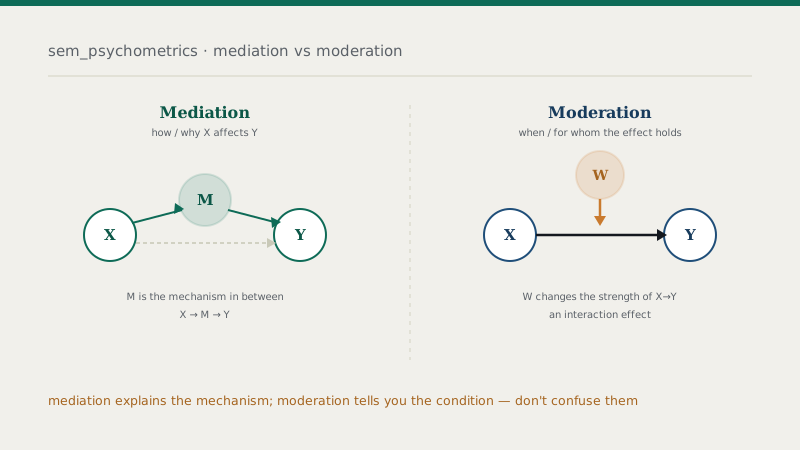
Mediation is about mechanism—the “how” or “why” behind an effect. A mediator is a variable that sits in the causal chain between the predictor and the outcome: X affects M, and M in turn affects Y, so that part or all of X’s effect on Y operates through M. Mediation answers the question: through what intervening process does X influence Y?
An example makes it concrete. Suppose a leadership style (X) improves team performance (Y). Mediation asks how: perhaps the leadership style raises team motivation (M), and it is the motivation that drives performance. Here motivation is the mechanism—the pathway through which leadership has its effect. When the whole effect runs through the mediator it is full mediation; when only part does, leaving a direct effect as well, it is partial mediation. Either way, the point of a mediation analysis is to open the black box and show the process connecting cause and outcome.
Moderation: the condition that changes the effect
Moderation is about condition—the “when” or “for whom” of an effect. A moderator is a variable that changes the strength or direction of the relationship between X and Y. The relationship between X and Y is not fixed; it depends on the level of the moderator. Moderation answers the question: under what conditions, or for which people, is the effect of X on Y stronger, weaker, or reversed?
Return to the example. Moderation asks whether the effect of leadership style (X) on performance (Y) depends on something else—say, team experience (W). Perhaps the leadership style boosts performance strongly for inexperienced teams but has little effect for experienced ones. Here team experience does not sit in the causal chain; it acts as a condition that alters how strong the X–Y link is. Statistically, moderation is an interaction effect: the effect of X on Y varies across levels of the moderator.
The one-line test: a mediator is in the path from X to Y (X→M→Y) and explains the mechanism; a moderator sits outside the path and changes how strong that path is. Mediation = how/why; moderation = when/for whom.
Why the distinction matters
The two are not interchangeable, and choosing the wrong one tests the wrong theory. If your theoretical claim is about a process—that X works by triggering M—you need a mediation analysis, and a moderation analysis simply cannot answer it. If your claim is about a boundary condition—that X’s effect holds here but not there—you need a moderation analysis, and mediation is irrelevant to it. The variable that is a mediator in one theory could be unrelated to a moderation question entirely; they are answers to different questions, not two tools for the same job.
They are also analysed differently. Mediation involves estimating and testing the indirect effect that runs through the mediator—modern practice uses methods such as bootstrapped confidence intervals for the indirect effect rather than the older, weaker step-based approach. Moderation is tested by including an interaction term between X and the moderator and examining whether it is significant, then probing the interaction to see how the effect changes across the moderator’s range. Applying the wrong analysis, or the outdated version of the right one, is a common reason these studies draw reviewer criticism.
When they combine: moderated mediation and mediated moderation
Real theories are often richer than pure mediation or pure moderation, and the two can be integrated. Moderated mediation (also called conditional indirect effects) asks whether a mediation effect itself depends on a moderator—does X work through M more strongly for some people than others? For instance, leadership might raise performance through motivation, but only for inexperienced teams. Mediated moderation describes the related case where a moderation effect operates through a mediator. These combined models are powerful for testing nuanced theory, but they are also more complex and demand a clear theoretical rationale and careful analysis—they should be specified because the theory calls for them, not to look sophisticated.
Getting it right
The discipline is to let your theory dictate the model. Before analysing, state precisely what you are claiming: is it that X influences Y through some intervening variable (mediation), or that the X–Y effect depends on some other variable (moderation), or a combination? Draw the path diagram—if the third variable sits between X and Y in the causal chain, it is a mediator; if it points at the arrow from X to Y and changes its strength, it is a moderator. Getting this right on paper, before touching the data, prevents the most common error: running a moderation analysis for a mediation hypothesis, or vice versa, and reporting a result that does not test the theory at all.
As always, both analyses assume the measurement underneath is sound—a mediation or moderation model built on poorly validated constructs inherits all their problems—and neither, on its own, establishes causation without a design that supports it. But with the constructs validated, the right model chosen for the right question, and current methods applied, mediation and moderation are among the most useful tools for turning a general relationship into a genuine understanding of how and when it works.
The bottom line
Mediation and moderation answer different questions and must not be confused. Mediation explains the mechanism—X affects Y through M (how and why). Moderation identifies the condition—the strength of X’s effect on Y depends on W (when and for whom), a statistical interaction. Which you need is dictated entirely by your theoretical claim, and each is analysed differently; the two can also be combined in moderated-mediation models when the theory genuinely calls for it. Draw the path diagram, match the model to the hypothesis, validate the measures, and use current methods—and you will test the theory you actually hold rather than a different one that happens to share the vocabulary.
Frequently asked questions
Building a mediation or moderation model?
From specifying the right model for your hypothesis to bootstrapped indirect effects and conditional-process analysis, our team can help you test how and when your effects hold—correctly.