Qualitative vs Quantitative Research: How to Choose
One of the earliest decisions in any study is also one of the most consequential: qualitative, quantitative, or both. The choice should follow from your research question—not your training or comfort zone. This guide explains the difference and how to decide.
Ask a room of researchers whether a project should be qualitative or quantitative and you will often get answers that reveal more about the researchers than the project—people gravitate to what they were trained in. But the two approaches are not rival worldviews to pick a side in; they are different tools that answer different kinds of question. Choosing well means starting from what you actually want to know and letting that dictate the method, rather than starting from a method and bending the question to fit it. Get this first decision right and everything downstream is easier; get it wrong and no amount of sophisticated analysis will rescue the study.
This guide explains what distinguishes qualitative from quantitative research, when each is appropriate, and how mixed methods combine them. It is a foundation for our guide to choosing the right statistical method and sits across our Qualitative & Mixed-Methods and Survey & Primary Research practices.
The fundamental difference
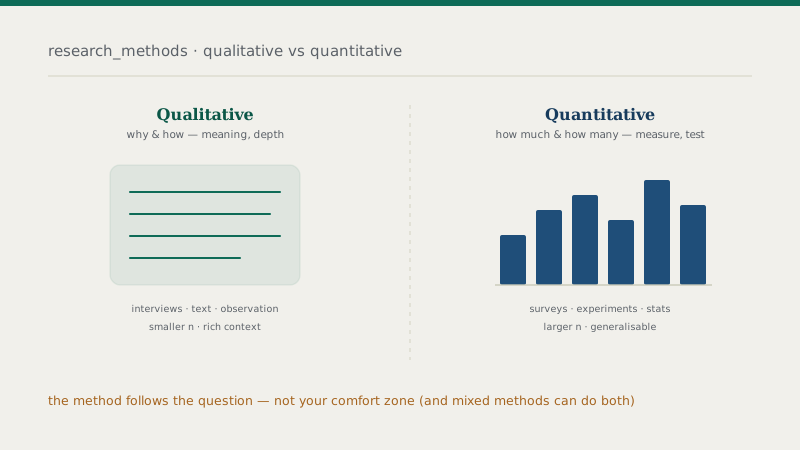
Quantitative research deals in numbers. It measures variables, tests hypotheses, and looks for patterns, relationships, and differences that can be expressed statistically and—with a representative sample—generalised to a wider population. Its characteristic questions are “how much,” “how many,” “how often,” and “is there a relationship between X and Y?” Its tools are surveys, experiments, and statistical analysis, typically on larger samples.
Qualitative research deals in meaning. It explores how people understand and experience things, seeking depth, context, and interpretation rather than measurement. Its characteristic questions are “why,” “how,” and “what does this mean to the people involved?” Its tools are interviews, focus groups, observation, and the analysis of text and other non-numerical data, typically on smaller samples studied in depth.
The essential contrast is between measuring and understanding. Quantitative research is strong at establishing how widespread something is and whether variables are related, but weak at explaining the meaning behind the numbers. Qualitative research is strong at uncovering the how and why and generating rich, contextual insight, but cannot tell you how common a pattern is or whether it generalises. Each is powerful for what it is designed to do and limited outside it—which is exactly why the question, not a preference, should drive the choice.
Neither approach is more rigorous than the other. Rigour is method-specific: a sloppy survey and a sloppy interview study are both weak, and a well-designed version of each is strong. The relevant question is never “which is better?” but “which answers this question?”
When to use quantitative research
Choose a quantitative approach when your question is about magnitude, frequency, or relationships that you want to measure and, ideally, generalise. It fits when you want to test a specific hypothesis, quantify how prevalent something is, compare groups numerically, establish whether and how strongly variables are related, or predict an outcome. If your goal is a finding that applies beyond your immediate sample—a defensible statement about a population—quantitative methods with appropriate sampling are the route. It also suits situations where the concepts are already well understood and can be measured with validated instruments.
When to use qualitative research
Choose a qualitative approach when your question is about meaning, process, or experience—when you need to understand why something happens or how people make sense of it. It is the right tool for exploring a phenomenon that is poorly understood, developing theory or hypotheses where little prior work exists, capturing the lived experience and perspective of participants, understanding context and process rather than outcomes alone, or investigating sensitive or complex topics that resist reduction to numbers. Where quantitative research can tell you that a pattern exists, qualitative research is often what tells you why.
The best of both: mixed methods
The choice is not always either/or. Mixed-methods research deliberately combines qualitative and quantitative approaches within a single study to draw on the strengths of both—and it is increasingly common precisely because many real questions have both a “how much” and a “why” component. A study might use qualitative interviews to explore a phenomenon and develop hypotheses, then a quantitative survey to test how widespread the patterns are; or run a quantitative analysis first and use qualitative work to explain the results. Done well, mixed methods can produce a fuller, more convincing account than either approach alone.
But mixed methods is not simply “do both”—it is more demanding, not less. It requires genuine expertise in each approach, a clear rationale for how the strands connect, and a design that specifies how and when they are integrated. Bolting a few interviews onto a survey without a coherent logic is not mixed-methods research; it is two half-studies. When the question genuinely spans measurement and meaning, and the design integrates the two thoughtfully, mixed methods is powerful—but it should be chosen for that reason, not as a way to avoid deciding.
How to decide
The decision procedure is simple to state and disciplined to follow: start with your research question and ask what kind of answer it needs. Does it call for a number—a measurement, a comparison, a test of a relationship you want to generalise? That points quantitative. Does it call for understanding—meaning, process, the why behind a behaviour? That points qualitative. Does it genuinely need both, with a clear plan to integrate them? That points to mixed methods. Only after the question has answered this should practical factors—your resources, timeline, data access, and the norms of your field and target journals—refine how you execute the chosen approach.
The mistake to avoid is the reverse: choosing the method first—because it is what you know, or what looks impressive—and then framing the question to suit it. That is how studies end up measuring what is easy rather than what matters, or gathering rich narrative when the question really demanded a generalisable estimate. Let the question lead, be honest about what each approach can and cannot deliver, and the methodological foundation of the whole project will be sound.
The bottom line
Qualitative and quantitative research are complementary tools, not competing camps: quantitative measures and generalises, qualitative explains and interprets, and neither is inherently more rigorous. The right choice follows from the research question—numbers and generalisation point quantitative, meaning and process point qualitative, and questions that genuinely need both point to a thoughtfully integrated mixed-methods design. Decide in that order—question first, method second, practicalities third—and resist the pull to let training or fashion make the choice for you. That single discipline, applied at the very start, is one of the highest-leverage decisions in the whole research process.
Frequently asked questions
Not sure which approach your question needs?
Our team can help you match method to question—designing rigorous qualitative, quantitative, or genuinely integrated mixed-methods studies that answer what you actually want to know.