How to Measure Research Impact: Metrics, Frameworks, and Limitations
Universities, funders, and accreditation bodies increasingly ask researchers to demonstrate their impact—but impact is far harder to measure than it sounds. This guide covers the main metrics, what they capture, and, crucially, what they miss.
“Demonstrate the impact of your research” is now a standard requirement—in grant applications, promotion cases, institutional reporting, and business-school accreditation. It sounds straightforward, but it hides a genuinely hard question: what is research impact, and how do you measure something that ranges from citations in other papers to changes in policy, practice, or public understanding years later? The metrics most people reach for capture only a slice of it, and used uncritically they can distort the very behaviour they are meant to assess. Measuring impact well means understanding both what the numbers show and what they leave out.
This guide sets out the layers of research impact, the main academic and broader metrics, the frameworks that structure impact assessment, and the limitations that make judgement indispensable. It complements our guide to evidencing research impact for AACSB and EQUIS accreditation and reflects the work of our Institutional Research & Analytics and Bibliometrics practices.
The layers of impact
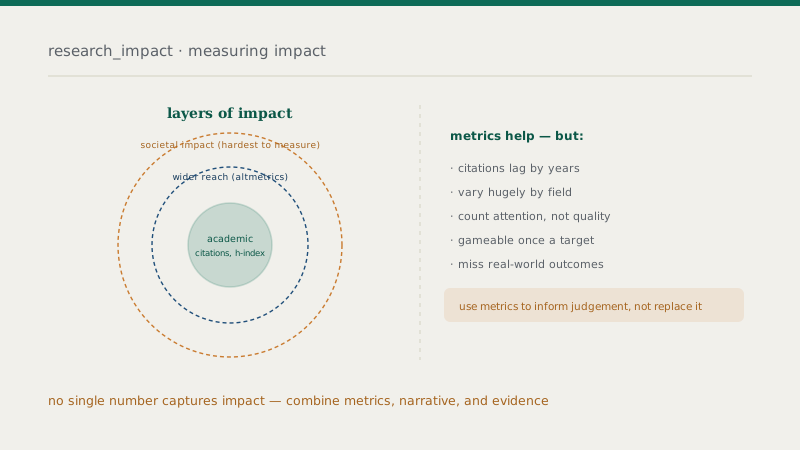
Research impact is not one thing but several, nested from the immediate and measurable to the profound and elusive. At the core is academic impact: influence on other research, captured by citations and their derivatives. Around it is wider reach: attention and uptake beyond formal citation—mentions in policy documents, media, professional practice, and online. Furthest out, and most important, is societal impact: real changes in the world—to policy, industry practice, public health, the economy, or public understanding—that research contributes to.
There is an uncomfortable inverse relationship here: the further out you go, the more meaningful the impact and the harder it is to measure. Academic citations are easy to count but capture only influence on other academics; societal impact is what most funders and institutions ultimately care about, yet it resists clean quantification, unfolds over long and uncertain timescales, and is difficult to attribute to any single piece of research. Any honest approach to measuring impact has to hold both facts at once.
Academic metrics—and their limits
The most established metrics measure academic impact through citations. Citation counts tally how often a work is cited. The h-index summarises a researcher’s output and impact together (a scholar with an h-index of 20 has 20 papers each cited at least 20 times). Journal-level metrics such as the Impact Factor or CiteScore describe the average citation rate of a journal, and field-normalised indicators attempt to make citation counts comparable across disciplines.
These metrics are useful precisely because they are objective, comparable, and easy to compute—but each carries serious limitations. Citations accrue slowly, so recent (often the most important) work is undercounted for years. Citation norms vary enormously by field, making raw comparisons across disciplines meaningless without normalisation. Citation counts measure attention, not quality or correctness—flawed papers can be highly cited, and a work can be cited to be criticised. Journal-level metrics say nothing about any individual article within the journal, so judging a paper by where it appeared is a well-known fallacy. And—following a principle often summarised as Goodhart’s law—any metric becomes gameable once it turns into a target, which is exactly what happens when metrics drive hiring, funding, and promotion.
A metric that becomes a target stops being a good metric. Once citations or journal placement determine careers, they get optimised for directly—which is why responsible research assessment uses metrics to inform expert judgement, never to replace it.
Beyond citations: altmetrics and broader reach
Because citations capture only academic influence, altmetrics (alternative metrics) attempt to measure wider reach—mentions in policy documents, news coverage, social media, and other non-academic channels. Their appeal is speed and breadth: they register attention long before citations accumulate and pick up impact outside academia entirely. Their weakness is that attention is not the same as impact—a viral paper is not necessarily an important one—and altmetric signals are noisy and, like all metrics, gameable. They are a useful complement to citations for painting a fuller picture, not a replacement, and they still measure attention rather than genuine outcomes.
Frameworks for impact assessment
Because no metric captures societal impact well, serious impact assessment has moved toward structured frameworks that combine quantitative indicators with qualitative evidence. The most influential model is the impact case study—a narrative that describes the underlying research, traces the pathway from that research to a real-world effect, and supplies concrete evidence of the change (adopted policy, changed practice, economic benefit), rather than relying on a citation count. This narrative-plus-evidence approach, prominent in national research assessment exercises and increasingly reflected in business-school accreditation, exists precisely because the impacts that matter most cannot be reduced to a number.
These frameworks are more demanding than pulling a metric from a database—they require articulating a credible chain from research to outcome and documenting it—but they measure something closer to what actually matters. For institutions preparing for accreditation or research assessment, the practical task is usually to combine the two: robust bibliometric evidence of academic impact alongside well-constructed narratives of broader and societal impact.
Using metrics responsibly
The consensus in the research community, reflected in widely endorsed statements on research assessment, is a set of sensible principles: do not rely on a single metric; do not use journal-level metrics to judge individual articles or people; account for disciplinary differences; combine quantitative indicators with qualitative expert judgement; and be transparent about how any assessment was made. The unifying idea is that metrics are tools to inform evaluation, not to replace the expert judgement of what a body of work actually contributes.
For a researcher or institution, this translates into a practical stance: use citation and related metrics to evidence academic impact, where they are genuinely informative; use altmetrics to show wider reach; build narrative case studies for societal impact; and never let a single number stand in for the whole picture. Demonstrating impact convincingly is about assembling a coherent, honest, multi-dimensional account—not chasing one figure.
The bottom line
Research impact runs from academic citations at the measurable core to societal change at the meaningful edge, and the two are in tension: the impact that matters most is the hardest to quantify. Academic metrics—citations, the h-index, journal indicators—are useful but limited, field-dependent, slow, and gameable, and they measure attention rather than quality. Altmetrics widen the view but share the problem. The impacts that matter most call for frameworks that combine metrics with narrative evidence, and the whole exercise depends on using numbers to inform judgement rather than substitute for it. Measure impact this way—multi-dimensional, honest about limitations, metric-informed but judgement-led—and you can demonstrate it credibly to funders, institutions, and accreditation bodies alike.
Frequently asked questions
Need to demonstrate your research impact?
From field-normalised bibliometric analysis to well-constructed impact case studies, our team can help you evidence academic and societal impact for funders, promotion, and accreditation.