Multicollinearity: When Is It a Problem?
Multicollinearity is one of the most feared—and most over-diagnosed—issues in regression. It can genuinely undermine an analysis, but only under specific conditions. Knowing when it matters, and when it doesn’t, prevents both false alarms and real mistakes.
Few regression issues cause as much unnecessary anxiety as multicollinearity. Researchers see a high correlation between two predictors, or a large variance inflation factor, and reach for drastic fixes—dropping variables, transforming everything, abandoning the model. Just as often, the opposite happens: multicollinearity that genuinely undermines a key conclusion goes unnoticed. The confusion comes from not distinguishing what multicollinearity actually does from what it doesn’t, and from not asking the one question that decides whether it matters at all: what are you trying to conclude?
This guide explains what multicollinearity is, what it does and does not affect, how to detect it, and—most importantly—when it is worth acting on. It is part of our regression assumptions series and reflects the diagnostic judgement in our Econometrics & Quantitative Research practice.
What multicollinearity is
Multicollinearity occurs when two or more predictors in a regression are highly correlated with one another—they carry overlapping information. In the extreme case of perfect multicollinearity, one predictor is an exact linear combination of others, and the model cannot be estimated at all. Far more common is high but imperfect multicollinearity, where predictors are strongly—but not perfectly—related. That is the case worth understanding, because it does not stop the regression from running; it quietly changes what the results can tell you.
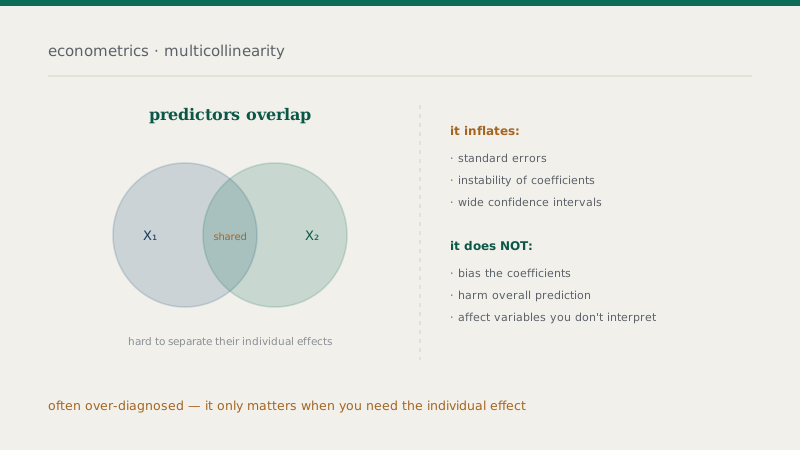
The intuitive picture is two predictors that overlap substantially. Because they move together, the data contains little independent variation to tell their separate effects apart. The regression still fits fine overall, but it struggles to attribute the shared influence to one predictor or the other—and that difficulty is the whole of the problem.
What it does—and doesn’t—affect
The key to keeping multicollinearity in perspective is knowing exactly what it touches. It inflates the standard errors of the affected coefficients, which makes them less precisely estimated—confidence intervals widen, t-statistics shrink, and effects that are real may fail to reach significance. It also makes those coefficients unstable: small changes to the data or the model specification can swing them substantially, sometimes even flipping their sign.
Crucially, though, multicollinearity does not bias the coefficients—they remain, on average, correct. It does not reduce the model’s overall fit or predictive power—the regression predicts the outcome just as well. And it does not affect the coefficients of predictors that are not collinear, nor the reliability of variables you are only including as controls rather than interpreting. This is the single most important thing to understand: multicollinearity is a problem of precision on specific coefficients, not of bias, fit, or the model as a whole.
The decisive question is what you need from the model. If you need to interpret the individual effect of a collinear predictor, multicollinearity matters. If those predictors are only controls, or your goal is prediction, it usually doesn’t matter at all.
How to detect it
Two practical tools cover most needs. The first is a correlation matrix of the predictors—a quick scan for pairs with high correlations flags the obvious cases, though it can miss multicollinearity involving three or more variables together. The second, and more complete, is the variance inflation factor (VIF), which quantifies how much each coefficient’s variance is inflated by its correlation with the other predictors. A VIF of 1 means no inflation; higher values mean more. Common rules of thumb flag values above 5 or 10 as worth attention—but they are rules of thumb, not laws, and a high VIF on a variable you don’t need to interpret is not automatically a problem.
When it actually matters
Multicollinearity matters when it threatens a conclusion you actually need to draw. If your hypothesis rests on the individual effect of a specific predictor, and that predictor is entangled with another, then the inflated standard error and unstable coefficient directly undermine your ability to make the claim—this is a real problem that must be addressed. If, on the other hand, the collinear variables are control variables whose individual coefficients you never interpret, or if your aim is prediction rather than explanation, the multicollinearity is harmless and can be left alone. Acting on it anyway—dropping a needed control to lower a VIF, for instance—can do more damage than the multicollinearity itself, by reintroducing omitted-variable bias.
What to do when it is a problem
When multicollinearity genuinely threatens an interpretation, several responses are available, in rough order of preference. The cleanest is often to collect more data if possible, since more independent variation directly reduces the imprecision—though this is not always feasible. Where predictors are conceptually redundant, combining them into a single composite or index resolves the overlap while retaining the information. In some cases the right move is to drop one of the redundant predictors—but only after confirming it is not needed to control for confounding, since removing a genuine confounder trades a precision problem for a bias problem. More advanced options, such as regularised regression, exist for prediction-focused settings. And sometimes the honest response is simply to acknowledge the limitation: report that the two effects cannot be cleanly separated with the available data, rather than forcing a precise-looking but fragile estimate.
The bottom line
Multicollinearity is real but routinely misjudged. It inflates standard errors and destabilises specific coefficients, but it does not bias estimates, harm prediction, or affect variables you aren’t interpreting. Whether it is a problem depends entirely on what you need from the model: a threat to a key individual effect deserves a considered response; multicollinearity among controls, or in a predictive model, is usually a non-issue. Diagnose it with a correlation matrix and VIFs, judge it against your research goal, and act only when a conclusion you actually need is at stake. That measured approach avoids both the false alarms and the genuine mistakes that surround this most over-diagnosed of regression problems.
Frequently asked questions
Not sure if multicollinearity is a real problem in your model?
Our team can diagnose it, judge it against what you actually need to conclude, and choose the response that protects your result—without over-correcting.