CB-SEM vs PLS-SEM: Which Should You Use?
Structural equation modelling comes in two families, and choosing between them is one of the most consequential—and most misunderstood—decisions in management and behavioural research. This guide explains the real difference, dispels the common myths, and helps you choose on the right grounds.
If your research involves latent constructs—things you cannot measure directly, such as satisfaction, trust, or organisational commitment, captured through several observed indicators—you will likely reach for structural equation modelling. And you will quickly face a fork: covariance-based SEM (CB-SEM), associated with software like AMOS, LISREL, and Mplus, or partial least squares SEM (PLS-SEM), associated with SmartPLS. The two can fit the same diagram and yet rest on different logic, serve different goals, and lead reviewers to expect different things. Choosing badly—or, worse, choosing by rumour—is a common and avoidable weakness.
This guide explains what actually separates the two approaches, corrects the myths that drive many poor choices (especially the “PLS is for small samples” one), and lays out the grounds on which the decision should really be made. It reflects how we approach latent-variable work in our SEM & Psychometrics practice, and it assumes the measurement question—are your constructs validly measured at all?—has been taken seriously first.
Two different philosophies
The fundamental difference is what each method is trying to do with your data. CB-SEM is covariance-based: it estimates model parameters by trying to reproduce the observed covariance matrix of your indicators as closely as possible. Its natural question is confirmatory—does the theoretical model I specified fit the pattern of relationships in the data? Because it aims to reproduce covariances, it yields the global model-fit indices researchers know well, and it is built for testing and comparing theories.
PLS-SEM is variance-based: rather than reproducing a covariance matrix, it estimates composite scores for the constructs and works to maximise the explained variance of the model's dependent constructs. Its natural question is predictive and exploratory—how well does this set of constructs predict the outcomes I care about, and what are the relationships among them? It is an approach oriented toward prediction and toward developing or extending theory, particularly in complex models.
This philosophical split—reproduce covariances to test theory, versus maximise explained variance to predict—is the root from which every practical difference grows.
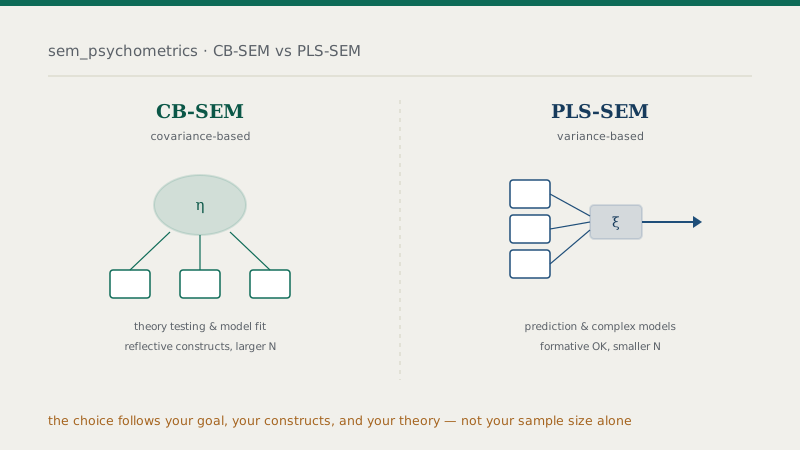
| CB-SEM | PLS-SEM | |
|---|---|---|
| Basis | Covariance-based | Variance-based |
| Goal | Confirmatory theory testing, model fit | Prediction and theory development |
| Constructs | Built for reflective measurement | Handles formative constructs naturally |
| Model fit | Global fit indices | Predictive assessment |
| Complex models | Can struggle | Copes comfortably |
| Deciding factor | Goal & constructs (not sample size) | Goal & constructs (not sample size) |
Myths that drive bad choices
Several persistent myths lead researchers to choose PLS-SEM for the wrong reasons. The most damaging is that PLS-SEM is the method for small samples. It is true that PLS-SEM can technically produce estimates with smaller samples than CB-SEM typically requires, but “can run” is not “is appropriate.” Small samples produce imprecise estimates whatever the method, and methodological research has been clear that small sample size alone is not a sound justification for choosing PLS-SEM. Using it as a workaround for inadequate data is exactly the kind of reasoning a careful reviewer now challenges.
A related myth is that PLS-SEM avoids assumptions, or is a “softer” method you can reach for when the data is messy. PLS-SEM has its own requirements and its own reporting standards, which have become considerably more demanding as the method has matured. It is not an escape from rigour; it is a different kind of rigour. Choosing between the two should never be a matter of which one is easier to get past a threshold.
Sample size is not the deciding factor. Choose based on your research goal, the nature of your constructs, and the maturity of your theory—then make sure your sample is adequate for whichever method that reasoning points to.
What should actually decide it
Three considerations should drive the choice.
The first is your research goal. If your aim is to test or compare theories and you want global model-fit evidence, CB-SEM is the natural fit. If your aim is prediction, or exploratory development of a theory, or explaining variance in key target constructs, PLS-SEM is designed for that. Confirmation versus prediction is the clearest single signal.
The second is the nature of your constructs—specifically whether they are reflective or formative. A reflective construct is one whose indicators are seen as effects of the underlying latent variable (the classic case: several survey items all reflecting the same underlying attitude). A formative construct is one whose indicators are seen as causes that together define the construct (for example, an index built from distinct components). CB-SEM is built around reflective measurement and handles formative constructs only with difficulty; PLS-SEM accommodates formative constructs more naturally. If your model genuinely contains formative constructs, that consideration weighs heavily.
The third is model complexity and theoretical maturity. PLS-SEM copes comfortably with complex models involving many constructs and indicators, and suits situations where the theory is still being developed. CB-SEM is well suited to well-established theories being rigorously tested. Neither is “more advanced”; they are tuned to different stages of the research cycle.
Measurement comes first, either way
Whichever family you choose, the credibility of the whole exercise rests on measurement. Before any structural path is interpreted, the constructs must be shown to be measured reliably and validly—that the indicators cohere as intended, that constructs are distinct from one another, and that the measurement model holds. A sophisticated structural model built on poorly validated measurement is a sophisticated way of drawing the wrong conclusion. Both CB-SEM and PLS-SEM have well-defined procedures for assessing the measurement model, and skipping or rushing them is one of the most common reasons SEM papers are rejected. This is why measurement precedes modelling is a principle we return to constantly: the order is not negotiable.
Reporting to current standards
Both methods have reporting expectations that have tightened over time, and reviewers apply them. For CB-SEM, that means reporting an appropriate set of fit indices and justifying the measurement model. For PLS-SEM, the standards have evolved notably in recent years—expectations now include specific assessments of reliability, validity, and, increasingly, of the model's actual predictive performance rather than in-sample fit alone. Applying either method to the standards of five years ago is a reliable way to attract an avoidable objection. Part of using SEM competently is knowing what your target journal and its reviewers currently expect, and reporting accordingly.
The bottom line
CB-SEM and PLS-SEM are not competitors where one is simply better; they are different tools for different jobs. CB-SEM reproduces covariances to test theory and provides global fit; PLS-SEM maximises explained variance to predict and to develop theory, and handles formative constructs and complex models more naturally. The choice should follow your goal, your constructs, and your theory's maturity—never sample size used as an excuse. And whichever you choose, validate your measurement first and report to current standards. Decide on those grounds and the choice is defensible; decide by rumour and it is the first thing a reviewer will unpick.
Frequently asked questions
Planning a latent-variable study?
From scale validation and measurement models to CB-SEM and PLS-SEM, our team can help you choose the right approach and meet current reporting standards.