P-Hacking and Researcher Degrees of Freedom: How to Keep Your Analysis Honest
The flexibility every researcher has in how they analyse data is also a trap: try enough analyses and something will cross the significance threshold by chance. Understanding p-hacking—often unintentional—and how to guard against it is central to producing findings that replicate.
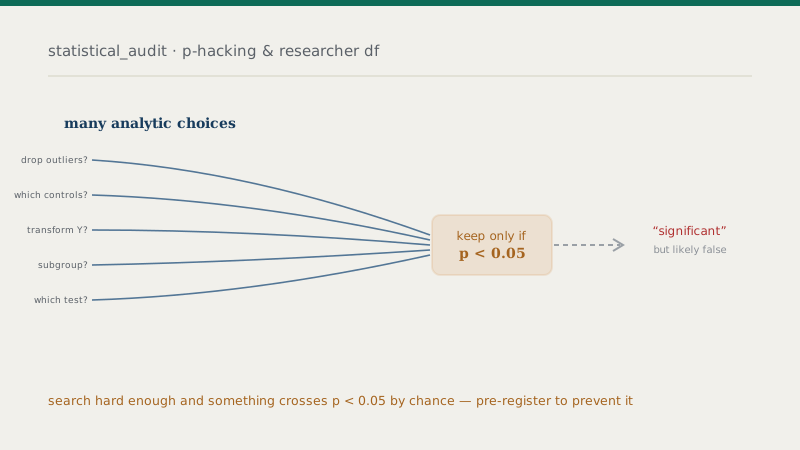
Between a dataset and a published result lie dozens of decisions: which observations to exclude, which control variables to include, how to transform a variable, which subgroups to examine, which of several defensible tests to run. Each choice is individually reasonable—and therein lies the danger. If you try many combinations and keep the ones that produce a statistically significant result, you will find significance whether or not any real effect exists, simply because you searched. This is p-hacking, and it is one of the central threats to the credibility of quantitative research—not usually because researchers are dishonest, but because the flexibility is so easy to exploit without noticing.
This guide explains p-hacking and the “researcher degrees of freedom” that enable it, why the problem is so insidious, and the practices—above all pre-registration—that keep an analysis honest. It reflects the research-integrity focus of our Statistical & Methodological Audit practice, and it connects to a theme running through much of our work: the difference between a finding that will replicate and one that only looks like a finding.
Researcher degrees of freedom
“Researcher degrees of freedom” is the term for all the legitimate choices available in collecting and analysing data. Should an outlier be removed? Which covariates belong in the model? Should the outcome be logged? Should the analysis run on the full sample or a subgroup? When should data collection stop? Each of these has more than one defensible answer, and the same data can yield very different results depending on the combination chosen—a phenomenon sometimes called “the garden of forking paths.”
The freedom itself is not the problem—analysis genuinely requires judgement. The problem is what happens when those choices are made after seeing the data, guided (even subconsciously) by which choices produce a more publishable result. At that point the flexibility stops being judgement and becomes a search for significance, and the reported p-value no longer means what it claims.
What p-hacking is
P-hacking is exploiting researcher degrees of freedom—consciously or not—until a result crosses the conventional significance threshold, and then reporting that result as if it were the single planned analysis. It takes many forms: trying different model specifications and reporting the significant one; testing many outcomes or subgroups and highlighting the hits; adding or dropping control variables until a coefficient becomes significant; collecting more data specifically when a result is not yet significant and stopping once it is; or choosing the exclusion rule or transformation that happens to work.
Why does this manufacture false findings? Because the standard significance threshold accepts a fixed rate of false positives per test. Run one test and that rate is controlled; run twenty and it is not—the chance that at least one crosses the line by pure luck rises steeply. A result plucked from many unreported attempts carries none of the assurance its p-value implies. The crucial and uncomfortable point is that this is usually unintentional: a researcher exploring the data in good faith, making a reasonable choice at each fork, following the significant path, can p-hack without any intent to deceive. That is precisely what makes it so pervasive and so hard to police.
A p-value assumes one pre-planned test. The moment a result is selected from many analyses, the reported p-value overstates the evidence. The problem is not the individual choices—it is choosing among them based on the outcome.
The distinction that matters: confirmatory vs exploratory
The key to keeping analysis honest is not to ban flexibility—that would be impossible and undesirable—but to be clear about which mode you are in. Confirmatory research tests a specific hypothesis specified in advance; here the significance threshold means what it claims, because there was one planned test. Exploratory research searches the data for patterns to generate hypotheses; this is valuable and legitimate, but its findings are provisional and must be labelled as such, because the p-values are not protected against multiple looks.
P-hacking, at root, is exploratory analysis dressed up and reported as confirmatory—presenting a pattern discovered by searching as though it had been predicted and tested once. There is nothing wrong with exploration; the dishonesty (again, often unwitting) is in the relabelling. Keeping the two modes distinct, and honest about which produced a given result, is the single most important discipline for credible analysis.
How to keep your analysis honest
Several practices protect against p-hacking, in rough order of power. The strongest is pre-registration: specifying the hypotheses, the analysis plan, the exclusion rules, and the sample size in advance, in a timestamped public record, before seeing the data (or the outcomes). Pre-registration does not forbid exploration—it simply makes the line between planned and post-hoc analysis visible and accountable, so a confirmatory claim can be trusted as confirmatory. It is increasingly expected, and in some fields required.
Where a full pre-registration is not feasible, related practices help: correcting for multiple comparisons when many tests are run, which restores honest error rates; reporting all analyses conducted, not just the significant ones, so readers can see the full search; robustness checks that show a result survives reasonable alternative choices rather than depending on one; and, powerfully, replication and out-of-sample testing—a finding that holds on new data was not a fluke of the original search. Underlying all of these is transparency: the more visible your analytic choices, the less room there is for undisclosed flexibility to distort the record.
Why it matters
P-hacking is a principal driver of the replication problems that have troubled many fields—published findings that fail to reproduce because they were artefacts of flexible analysis rather than real effects. For an individual researcher, the risk is producing a result that does not hold up, damaging the work and the reputation behind it. For the field, the cost is a literature polluted with false positives. This is also why an independent statistical audit looks specifically for signs that a result may depend on undisclosed analytic choices: catching that fragility before publication protects both the paper and the record. Keeping analysis honest is not a constraint on good research—it is what makes research findings worth believing.
The bottom line
Every analysis involves defensible choices, and making them based on which gives a significant result—even unintentionally—turns that flexibility into p-hacking, producing findings that will not replicate. The remedy is not to eliminate judgement but to keep confirmatory and exploratory work distinct and honestly labelled, and to constrain the confirmatory path through pre-registration, multiple-comparison correction, full reporting, robustness checks, and replication. Analysis conducted and reported this way earns the trust its p-values claim. Analysis that quietly searches for significance produces confident numbers that mean far less than they appear to—and often nothing at all.
Frequently asked questions
Want confidence your result will replicate?
Our team can help you pre-register, keep confirmatory and exploratory work distinct, and independently check whether a finding depends on undisclosed analytic choices—before you submit.