How Business Schools Can Evidence Research Impact for AACSB and EQUIS Accreditation
Both AACSB and EQUIS now expect business schools to show that their research matters—not just that it was published. This guide explains what the current standards ask for, how the definition of impact has broadened, and how to build the evidence base that a peer-review team will actually find convincing.
For a long time, a business school could evidence the strength of its research largely by counting outputs: publications in ranked journals, citation totals, the number of faculty classified as academically qualified. That era is ending. Both major institutional accreditations—AACSB and EQUIS—have moved decisively toward a broader, evidence-based understanding of research impact, one that asks not only how much a school publishes but what difference its scholarship makes to practice, policy, teaching, and society. For accreditation and reaccreditation teams, that shift changes what you need to prepare, and it rewards schools that can tell a credible, evidenced story about their research rather than simply tabulating it.
This article sets out what the current AACSB and EQUIS expectations actually are, where they align, and how a school can build the kind of evidence base a peer-review team finds convincing. It is written for research offices, accreditation leads, and faculty leadership preparing a self-assessment or continuous-improvement review. Our institutional accreditation support is built around exactly this work—helping schools analyse and communicate credible research evidence—and this guide is the thinking behind it.
A note on positioning. No consultancy can “deliver” accreditation—AACSB and EQUIS are mission-driven, peer-reviewed processes that a school earns through its own evidence and continuous improvement. What external analysts can do is help a school build, analyse, and communicate that evidence credibly. This guide is written in that spirit: it is about strengthening your evidence, not shortcutting the process.
What changed: AACSB's 2026 standards and the impact framework
AACSB released its 2026 Global Standards for Business Education—the first major revision since 2020. Importantly, the change is one of framing and emphasis rather than a wholesale reinvention: the framework still rests on nine core standards. What is new is how they are organised and explained. The 2026 standards group Standards 7, 8, and 9 under a newly titled section, Pathways to Impact, presenting teaching, scholarship, and societal impact as three complementary ways a school can create and demonstrate value, rather than as separate, siloed requirements.
For research offices, two standards sit at the centre of this. Standard 8, Impact of Scholarship, addresses the quality and impact of a school's intellectual contributions. Standard 9, Societal Impact and Engagement, addresses the school's engagement with, and contribution to, wider society. The Pathways to Impact framing matters because it explicitly recognises that schools have different missions: some create impact primarily through teaching, others through research, others through societal engagement—and a school is expected to demonstrate impact through the combination that genuinely aligns with its mission, not a single prescribed formula.
Alongside the standards, in May 2026 AACSB and a coalition of ten global academic organisations released A Framework for Research Impact: Insights, Pathways, and Calls to Action, developed by a Global Research Impact Task Force. The framework advances a broader view of research impact—one that connects scholarship not only to academic knowledge but to business practice, public policy, education, and society—and it comes with practical resources, including a Research Impact Assessment Tool and a Research Impact Ecosystem Guide, to help schools evaluate their current practices and identify where to improve. The direction of travel is unambiguous: schools are increasingly expected to define, assess, and communicate impact in terms that reach beyond citation counts.
What EQUIS expects on research
EQUIS, the flagship institutional accreditation of EFMD Global, evaluates a school across multiple dimensions rather than research alone, and two of its defining emphases are directly relevant here: a strong focus on internationalisation and on engagement with the world of business and practice. On research specifically, EQUIS has long expected a school to have a clearly defined research and publication policy through which faculty are encouraged to develop distinctive areas of expertise—and, consistent with its wider philosophy, to show that this research connects to practice and has reach beyond a purely national footprint.
EQUIS also treats ethics, responsibility, and sustainability as a dimension that runs across the whole institution, including its research portfolio. In practice, this means a school preparing for EQUIS is not only asked what it publishes, but how its research engages internationally, how it connects to business and practice, and how responsibility and sustainability are reflected in its scholarly work. The evidential demands therefore overlap substantially with AACSB's broadened impact agenda, even though the two systems assess against different frameworks and processes.
Outputs, outcomes, and impact: the distinction that matters
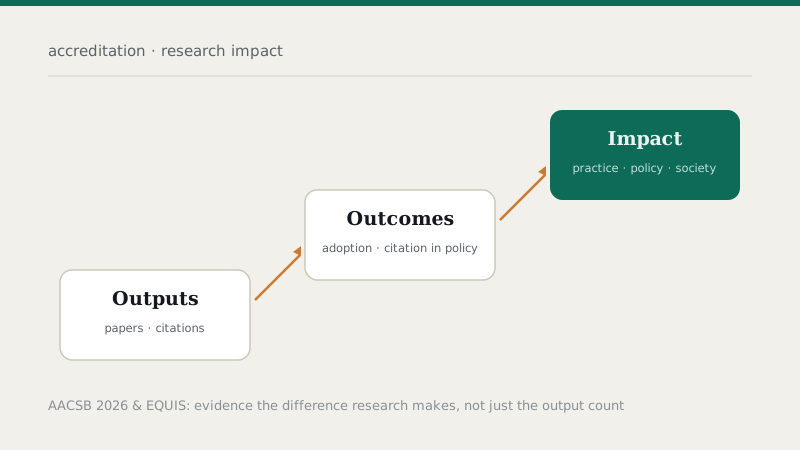
The single most useful concept for preparing an accreditation research narrative is the distinction between outputs, outcomes, and impact. An output is what the research produced—a journal article, a book chapter, a dataset, a case study. An outcome is what changed as a proximate result—a method adopted by other researchers, a finding cited in a policy consultation, a tool used in teaching. Impact is the wider difference the research ultimately made—to a practice, a policy, an industry, a community. Traditional metrics measure outputs well and outcomes poorly; they barely touch impact at all.
Both accreditation systems are, in effect, asking schools to climb this ladder—to evidence not just that outputs exist, but that they lead to outcomes and, where possible, to demonstrable impact. This is harder, because impact is often indirect, delayed, and difficult to attribute cleanly to a single study. But it is also where a well-prepared school can distinguish itself, because most schools still default to output counting. A research narrative that traces credible pathways from scholarship to real-world change—supported by evidence at each step—is exactly what the current frameworks reward.
Building the evidence base
Evidencing impact well is a data and analysis problem before it is a writing problem. A convincing self-assessment rests on several kinds of evidence, assembled deliberately rather than gathered in a rush before a review.
The foundation is a clear, well-maintained picture of the school's research portfolio: what is being produced, by whom, in what areas, and how it maps to the school's stated mission and strategic priorities. This is where rigorous bibliometric and scientometric analysis earns its place—not to reduce research to a single number, but to map the shape of a school's scholarship: its thematic strengths, its collaboration and co-authorship networks, its international reach, and how these have evolved. A well-constructed bibliometric picture answers questions a review team will ask, such as where the school's genuine areas of distinctive expertise lie and how internationally connected its research is.
On top of that foundation sits impact evidence: the traceable connections between scholarship and change. This can include documented uses of research in policy or practice, engagement with non-academic partners, contributions to teaching and curriculum, media and public engagement, and case narratives that follow a body of work from publication through to its effect. The AACSB framework's emphasis on an impact ecosystem is a useful prompt here: impact rarely comes from a single paper, but from a sustained programme of work connected to the outside world.
Finally, the evidence needs a coherent narrative that ties the portfolio and the impact evidence to the school's mission. Accreditation is mission-driven: a peer-review team is assessing whether a school delivers on its own stated purpose, not against a universal template. The strongest submissions read as a consistent story—this is our mission, these are the research strengths that serve it, and here is the evidence that our scholarship makes the difference we claim.
Common gaps that weaken a research submission
Several avoidable weaknesses recur in research self-assessments. The first is relying on output counts alone—presenting publication and citation tallies as if they were impact, when the frameworks now explicitly ask for more. The second is a portfolio that does not map to the mission: strong research that sits disconnected from the school's stated strategic priorities is harder to present as evidence of mission delivery. The third is thin impact evidence: claims of real-world influence that are asserted rather than documented. The fourth, particularly relevant for EQUIS, is underevidenced international reach and practice engagement—treating these as afterthoughts rather than as dimensions to be demonstrated. And the fifth is leaving evidence-gathering too late, so that the review becomes an exercise in reconstruction rather than a reflection of an ongoing, well-documented research strategy.
Most of these gaps are analytical and can be closed with the right preparation. Mapping the portfolio properly, identifying where impact evidence genuinely exists, and structuring the narrative around the mission are all tractable tasks—provided they are approached as a continuous-improvement activity rather than a pre-review scramble.
How MAS Research supports institutions
Our role in this work is to help a school build, analyse, and communicate credible research evidence—never to claim we can secure an accreditation outcome, which no external party can honestly promise. In practice, that support draws on our research-intelligence and bibliometric capabilities to map a school's research portfolio, its distinctive strengths, and its international and collaborative reach; on rigorous analysis to identify and structure impact evidence; and on the framing needed to connect all of it to the school's mission in a way a review team will find coherent. The aim is an evidence base that is honest, defensible, and genuinely useful to the school—beyond the review cycle itself.
The broader point is that the shift in both AACSB and EQUIS toward evidenced impact is not merely a compliance burden. It is an invitation to understand, and to articulate, what a school's research actually achieves. Schools that treat it that way—building a clear picture of their scholarship and its effects as an ongoing discipline—find that the accreditation narrative largely writes itself, because the evidence is already there. For those preparing a review now, the practical starting point is simple: map the portfolio, find the impact evidence, and connect both to the mission. Everything else follows from that foundation.
Frequently asked questions
Preparing a research self-assessment for AACSB or EQUIS?
We help business schools map their research portfolio, build credible impact evidence, and connect it to their mission. Explore our institutional research intelligence, or tell us where you are in the cycle.