Heteroskedasticity: What It Is and How to Handle It
Heteroskedasticity is one of the most common violations of the regression assumptions—and one of the easiest to handle correctly once you understand what it does. This guide explains what it is, why it matters for inference, how to detect it, and the standard fix.
Heteroskedasticity is a word that sounds far more intimidating than the problem it describes. Strip away the Greek, and it simply means that the variability of the errors in a regression is not constant—the model predicts some observations more precisely than others. It is genuinely common in real data, especially in cross-sectional and financial applications, and it violates one of the standard regression assumptions. The good news is that, once you understand exactly what it affects, it is one of the most straightforward problems to deal with.
This guide explains what heteroskedasticity is, why it matters (and, importantly, what it does not break), how to detect it, and the standard remedies. It is part of our regression assumptions series and reflects the everyday diagnostic practice in our Econometrics & Quantitative Research work.
What heteroskedasticity is
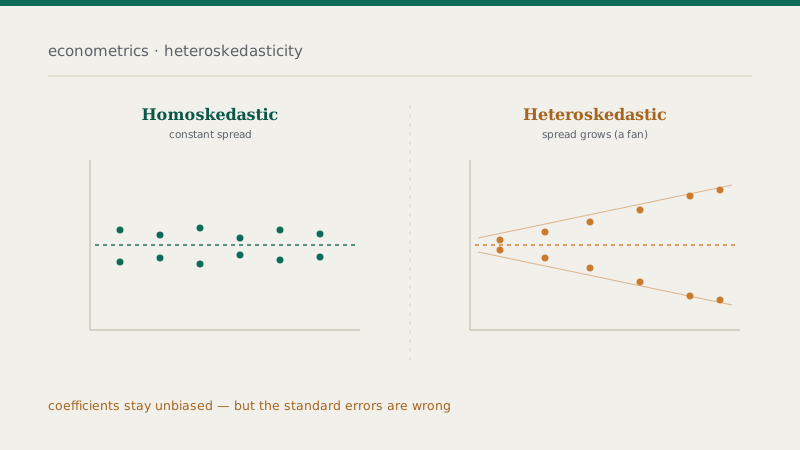
One of the assumptions behind ordinary regression is homoskedasticity: the errors have constant variance across the whole range of the data. Heteroskedasticity is the violation of that assumption—the error variance changes systematically, usually growing or shrinking as a predictor changes. The classic picture is a residual plot that fans out into a cone shape: at low values of a predictor the residuals cluster tightly around zero, and at high values they spread far wider.
It has intuitive causes. Consider modelling household spending as a function of income: low-income households have little discretion, so their spending is predictable, while high-income households vary enormously in how much they spend—so the model’s errors are naturally larger at the top of the income range. That is heteroskedasticity, and it reflects something real about the data rather than a mistake in the analysis.
Why it matters—and what it doesn’t break
The most important thing to understand about heteroskedasticity is precisely what it does and does not affect—because it is often over-feared. It does not bias the coefficients: your estimated slopes remain, on average, correct, and the model’s point estimates are still valid. What heteroskedasticity breaks is the standard errors. Under heteroskedasticity, the usual formula for the standard errors is wrong, which means the t-statistics, p-values, and confidence intervals built on them are unreliable—typically making results look more statistically significant than they really are.
So the consequence is specifically about inference, not estimation. Your coefficients are fine; your conclusions about whether they are statistically significant are not, until the standard errors are corrected. That framing matters, because it tells you the fix does not require changing your model or your estimates—only the way uncertainty around them is computed.
Heteroskedasticity breaks the standard errors, not the coefficients. That is why the standard remedy corrects the inference without touching the estimates—and why treating a heteroskedastic regression as if its p-values were trustworthy is the real mistake.
How to detect it
Detection is straightforward and should be routine. The first and most informative step is visual: plot the residuals against the fitted values (and against individual predictors). A random, even band of points around zero suggests homoskedasticity; a fan, cone, or any systematic change in spread signals heteroskedasticity. The eye catches this quickly, and it often reveals the pattern more usefully than a test.
For a formal check, two tests are standard: the Breusch–Pagan test and White’s test. Both assess whether the error variance is related to the predictors, with White’s test being the more general (it also picks up certain non-linear patterns). A significant result indicates heteroskedasticity. As always, a test is a supplement to the residual plot, not a replacement—the plot tells you the shape of the problem, the test gives a yes/no with a p-value.
How to handle it
The dominant, low-cost solution is robust standard errors—specifically, heteroskedasticity-consistent (often called White or Huber–White) standard errors. These recompute the standard errors in a way that remains valid under heteroskedasticity, correcting the t-statistics, p-values, and confidence intervals without changing the coefficients at all. They are trivial to apply in any modern statistical package and have become so routine that many applied researchers now report robust standard errors by default, whether or not a test flags a problem—a sensible, low-risk habit.
For clustered data—observations grouped within firms, schools, or regions—clustered standard errors extend the same idea, allowing for both heteroskedasticity and correlation within clusters. Other approaches exist: weighted least squares can improve efficiency if you can model the variance structure well, and transforming the dependent variable (a log transformation, for instance) sometimes reduces heteroskedasticity by stabilising the variance. But in the great majority of applied work, robust standard errors are the appropriate, expected, and sufficient response.
The bottom line
Heteroskedasticity is common, easy to detect, and easy to handle—so it should never be a source of anxiety or, worse, of untrustworthy conclusions. Remember the essentials: it does not bias your coefficients, but it does invalidate the usual standard errors, which distorts your inference. Look for it in a residual-versus-fitted plot, confirm with a Breusch–Pagan or White test if needed, and correct it with robust (or clustered) standard errors, which fix the inference while leaving your estimates untouched. Handled this way, heteroskedasticity moves from an intimidating word to a routine box checked—exactly what a careful reviewer expects to see.
Frequently asked questions
Want your regression inference to hold up?
From detecting heteroskedasticity to applying the right robust or clustered standard errors, our team makes sure your p-values mean what you think they do.