Common Method Bias: What It Is and How to Reduce It
When the same respondent provides both your predictor and your outcome in the same survey, part of the relationship you observe may be an artefact of the method—not a real effect. Common method bias is one of the most scrutinised threats in survey research, and it is best designed against, not corrected after the fact.
Much of management and behavioural research relies on surveys in which a single respondent answers questions about both the independent and the dependent variables, at the same time, in the same questionnaire. It is convenient and often unavoidable—but it introduces a subtle and serious problem. Some of the correlation you observe between the variables may arise not because they are genuinely related, but because they were measured the same way, by the same person, in the same sitting. This is common method bias (or common method variance), and in survey-heavy fields it is one of the first things a knowledgeable reviewer looks for.
This guide explains what common method bias is, why it matters, and—most importantly—how to reduce it, with the emphasis firmly on prevention through design rather than after-the-fact statistical rescue. It builds on our guide to designing a valid survey and reflects the primary-research practice in our Survey & Primary Research work.
What common method bias is
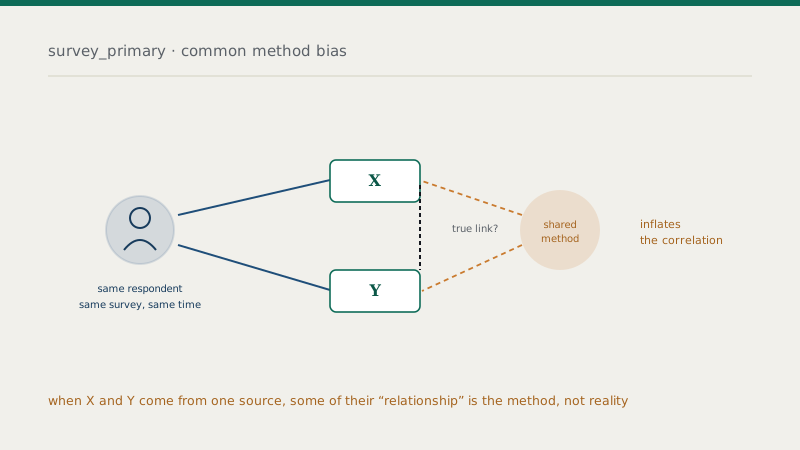
Common method bias is variance that is attributable to the measurement method rather than to the constructs the measures are supposed to represent. When the same source and format generate both the predictor and the outcome, systematic features of that shared method—the respondent’s consistent way of using rating scales, their mood on the day, a wish to appear consistent, the priming of one question by another—can create or inflate an apparent relationship between variables that would look weaker, or different, if measured independently.
The consequence is a threat to construct validity: the observed correlation partly reflects the method, so effect sizes can be overstated and, in some cases, relationships can appear where little exists. Because so much survey research draws both sides of a relationship from one respondent at one time, common method bias is a pervasive concern—which is exactly why reviewers scrutinise it and why addressing it has become an expected part of survey-based work.
Where it comes from
The sources of common method bias are worth naming, because each suggests a way to design against it. Some arise from the respondent: consistency motifs (the desire to appear consistent across answers), acquiescence (a tendency to agree regardless of content), and social-desirability pressures all impose a systematic pattern across a person’s answers. Others arise from the item and instrument: similarly worded items, a shared response scale, ambiguous questions, and the context created by neighbouring questions can all induce artificial commonality. The unifying theme is that anything shared across the measurement of X and Y—the person, the moment, the format—can leak into the correlation between them.
Prevention beats correction. The most effective defences against common method bias are design choices made before data collection. Post-hoc statistical checks can assess whether a problem is likely present, but they cannot reliably remove a bias that a better design would have prevented.
Reducing it through design
The strongest remedies are procedural—built into how you collect the data. The most powerful is to separate the sources or the timing of measurement. Obtaining the predictor and the outcome from different sources (for example, self-reported attitudes paired with an objective or supervisor-rated outcome) breaks the shared-source link almost entirely. Where a single source is unavoidable, introducing a temporal separation—measuring the predictor and the outcome at different points in time—substantially weakens the shared-moment effect. Either of these design choices does more to protect a study than any statistical adjustment can.
Several questionnaire-design tactics help further: guaranteeing respondent anonymity and assuring respondents there are no right or wrong answers reduces social-desirability and evaluation-apprehension effects; separating the items for different constructs in the questionnaire (rather than grouping them) reduces priming; varying scale formats and wording, and writing clear, unambiguous items, reduces artificial commonality. None of these is difficult, and together they materially lower the risk before a single response is analysed.
Assessing it statistically
Design comes first, but statistical checks have a role in assessing whether common method bias is likely to be a problem in data already collected. Various diagnostic approaches exist for this—from simple exploratory checks to more sophisticated modelling that attempts to account for a common method factor. These are useful for gauging the severity of the concern and for demonstrating to reviewers that it has been considered.
But their limits must be understood honestly. The older, simplest diagnostics are widely regarded as weak and are no longer considered convincing on their own; more sophisticated model-based approaches have their own assumptions and debates. Crucially, none of these techniques can reliably fix common method bias after the fact—at best they characterise it. Relying on a post-hoc test in place of sound design is exactly the reasoning a careful reviewer challenges. The statistical check supports a well-designed study; it does not rescue a poorly designed one.
Keeping it in proportion
A final word on balance. Common method bias is a genuine threat that deserves serious attention—but it is neither automatically fatal nor always large. Its likely severity depends on the constructs, the design, and the context, and a single-source study is not worthless simply because it is single-source. The right stance is neither to ignore the issue nor to treat every same-source correlation as pure artefact, but to design against it where you can, assess it honestly where you cannot, and report transparently what you did. A study that anticipates the concern and addresses it through design is credible; one that neither prevents nor acknowledges it invites the objection that undoes much survey research.
The bottom line
Common method bias arises when the shared method behind two measures—same respondent, same time, same format—inflates their observed relationship, threatening construct validity in survey research. The most effective defences are design choices: separate the sources or the timing of measurement, protect anonymity, separate and vary the items. Statistical diagnostics can assess whether a problem is present but cannot reliably remove it, so they supplement good design rather than substitute for it. Take the threat seriously, design against it up front, keep it in proportion, and report what you did—and a single-source survey can still support conclusions a reviewer will accept.
Frequently asked questions
Worried about method bias in your survey?
From multi-source and time-lagged designs to questionnaire safeguards and honest assessment, our team can help you design out common method bias—and defend it in review.